100% Wi-Fi-capable fleet visibility
Every Samsung device with a Wi-Fi radio is observable from the moment it powers on — with or without SmartThings setup. Doubles effective fleet coverage against the ~50% industry-average connection rate.
Every Samsung device that ships a Wi-Fi radio becomes a node on a global observation network — visible whether the customer ever connects it to SmartThings or not. Doubling the addressable fleet, closing the SmartTag distance ceiling, and beating Apple Find My on the one metric Samsung can actually win.
Troverlo runs a connectionless, firmware-only payload on Wi-Fi radios Samsung already ships — Galaxy phones and Books, Bespoke appliances, Neo QLED and The Frame, Galaxy Watch and Buds, SmartThings hubs, Harman head units in the car. Beacon and scan only. Same power class as BLE. No data connection. No association. No handshake. No new BOM. No consumer setup.
Every device becomes both an observation point and an observable asset — from the moment it powers on, whether the customer ever links it to SmartThings or not. Combined with our strategic partnership with HERE Technologies and the wider Troverlo partner ecosystem, the result is an observation network Apple cannot out-density outside its home market.
LG has publicly acknowledged that less than half of its smart appliances stay connected after installation. Whirlpool says "more than half" but has declined to specify. In Samsung's best market — Korea — 76% of Wi-Fi-enabled Samsung appliances released after 2017 are on SmartThings. Globally, Samsung has not published the number, which is itself telling.
A connectionless Wi-Fi payload does not depend on the customer completing setup, entering credentials, keeping the app installed, or updating Wi-Fi after a router change. Every Wi-Fi-capable Samsung device is visible on the observation network from the moment it powers on. Doubled effective fleet coverage. No consumer action required.
The observation layer is not just HERE. Every Troverlo partner and customer contributes observations back into the same fabric — enterprise endpoint fleets, industrial silicon modules, government IT deployments, defense mission assets, and OEM integrations under active development across power tools, connected fitness, e-bikes, and pro audio. Samsung's home appliances, mobile, wearable, TV, and automotive fleets would each participate the same way.
Samsung joining does not just extend the network to their fleet — every Samsung Wi-Fi radio both contributes observations and is observed by every other partner endpoint, in every environment those endpoints operate. This is a genuine two-sided ecosystem: value grows non-linearly with each new participant, and Samsung's home-appliance, mobile, wearable, TV, and automotive fleets each amplify the network for every other participant while gaining the benefit of everyone else's presence.
Galaxy SmartTag and SmartTag2 depend on Bluetooth Low Energy and on another Galaxy phone being nearby — with SmartThings Find on, Bluetooth on, and location services set to "Always allow." That is the same 300-foot dependency every BLE tracker platform lives under.
Apple wins Find My globally because there are roughly a billion iPhones with Find My on. Samsung cannot out-density Apple in the US. But Samsung plus Troverlo does not have to — Wi-Fi observation, backed by HERE and the wider partner ecosystem, is the technical leap that changes the math outside the US, where the Galaxy fleet is already dominant.
Requires another Galaxy phone with SmartThings Find on, nearby.
HERE, partner endpoints, and every Samsung Wi-Fi radio — connected or not.
Every Samsung device with a Wi-Fi radio is observable from the moment it powers on — with or without SmartThings setup. Doubles effective fleet coverage against the ~50% industry-average connection rate.
Continuous device state, presence, and location off every product line — Galaxy, appliance, TV, wearable, automotive — without an active app session or a paired phone. Feeds SmartThings directly.
Assets are seen and located without associating to any network, without a SIM, and without a paired phone. Works when the target is off, off-network, unpaired, or in a market where the Galaxy app population is thin.
Beacon and scan only. No Wi-Fi data connection, no association, no handshake. Same power budget as BLE, orders of magnitude below anything carrying a Wi-Fi data session.
Runs on the Wi-Fi radios Samsung already ships, backed by the global observation network Troverlo already operates. No gateways, no hubs, no SDK on the consumer phone.
Replace or complement the BLE radio with a Troverlo Wi-Fi observation payload. Ships with the HERE global network and partner ecosystem from day one. Leapfrogs AirTag on global density immediately — without adding a subscription, a SIM, or a new app requirement.
Bespoke appliances, SmartThings hubs, Galaxy Book, Galaxy Watch, The Frame, Neo QLED — every Samsung product becomes an observation point for every other Samsung product, and visible on the network from power-on. SmartThings Find becomes the category leader, not the category follower.
Harman head units contribute moving Wi-Fi observations to the same network HERE contributes to — scaling with new-car sales, across every automaker Harman ships into. A first-of-its-kind moving observation fabric.
Paths 01–03 monetize inside the Samsung ecosystem. Path 04 monetizes outside it.
The moment a Troverlo-integrated payload rides inside the Samsung Wi-Fi module, that module becomes the differentiator no other Wi-Fi chip vendor can match. Any PC OEM that designs it in inherits offline lock, wipe, and locate capability without adding a cellular BOM or sourcing a second radio. Any consumer-product maker, industrial-equipment supplier, medical-device builder, or appliance manufacturer that designs it in inherits offline telemetry — location, presence, and state — without adding a hub, gateway, or subscription.
Silicon distribution becomes platform distribution. Every Samsung Wi-Fi chip Samsung LSI ships into a non-Samsung device is a new observation point on the network and a new device visible in SmartThings' fabric — with no third-party OEM outreach, no partner integration engineering, no license negotiation. The chip does the work.
This is where the SmartThings platform stops being a Samsung ecosystem story and becomes an industry-wide observation-and-control layer — Samsung LSI selling the ability to be seen and controlled offline, at silicon economics, across every device category that ships a Wi-Fi radio.
Differentiated Samsung silicon commands a premium versus commodity Wi-Fi SoCs from Realtek, MediaTek, and others. Enterprise-grade offline capability is not a feature buyers can price-compare across silicon vendors, because Samsung LSI is the only vendor that can deliver it.
Every third-party device shipping the chip becomes visible in SmartThings without SmartThings having to onboard the OEM. Fleet grows non-linearly with silicon volume, independent of ecosystem-integration effort.
Samsung LSI designs the connectivity SoCs. Samsung Foundry manufactures them. Samsung Electronics ships them across mobile, appliance, TV, and Harman automotive. That collapses the OEM-vs-silicon-vendor dance every other prospect has to run — and it is the reason Samsung is uniquely positioned to make Wi-Fi observation a platform-wide feature, not a per-product integration.
The pitch, in one line: every Samsung Wi-Fi radio, one firmware payload, one global observation network. Beat Find My where Apple cannot follow, and see the half of your fleet that has never been connected.
A first-party comparison. Two devices signed into the same Microsoft account and instrumented with Troverlo. Both actually sitting at Lucky Goat Coffee, 3345 University Dr E, Bryan, TX. Screenshots captured on August 19, 2026 between 9:37 and 9:44 AM CDT. Nothing staged, nothing recreated.
From account.microsoft.com/devices, signed into the same account that owns both devices, captured between 9:41 and 9:43 AM CDT on August 19, 2026.
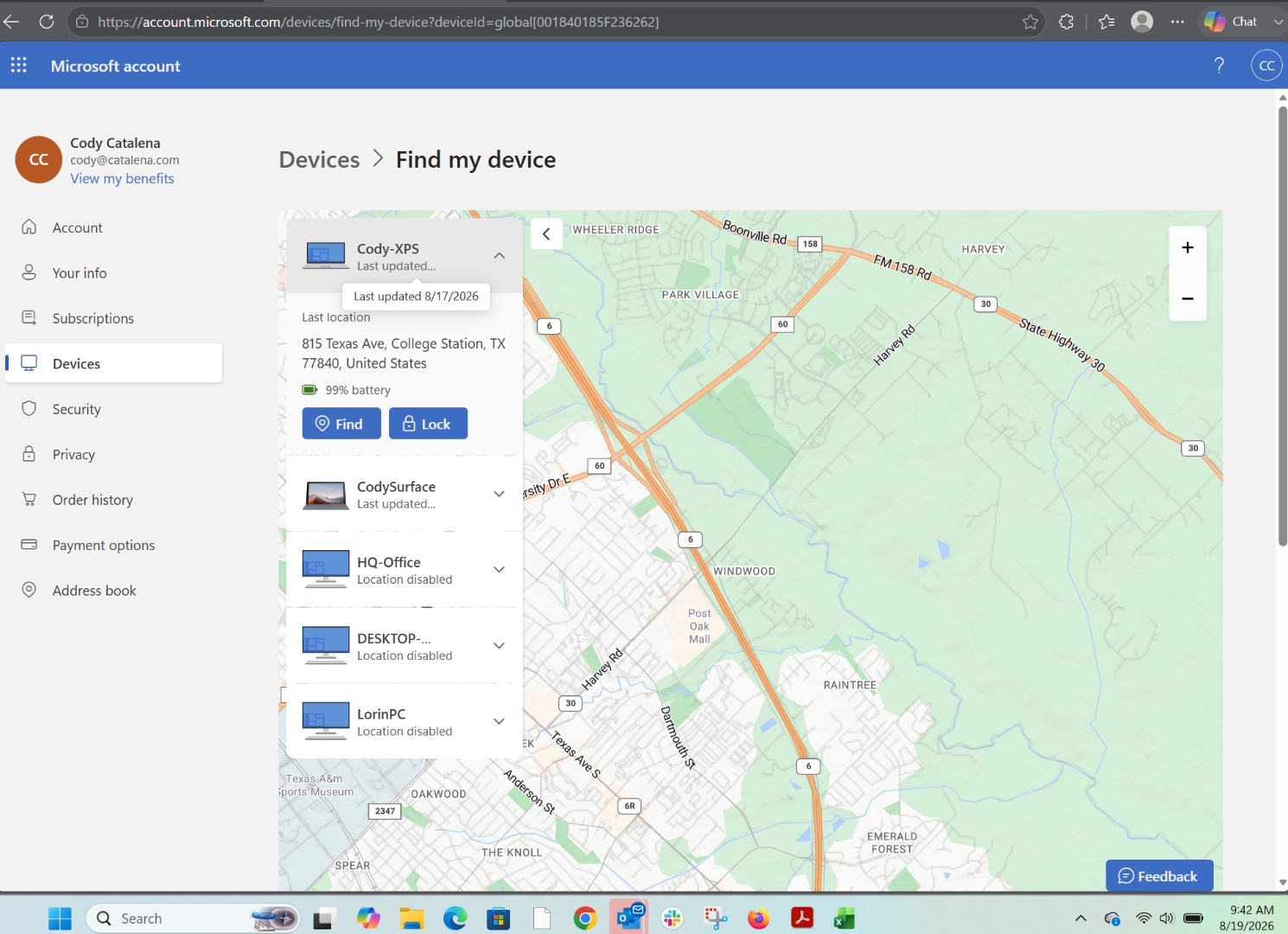
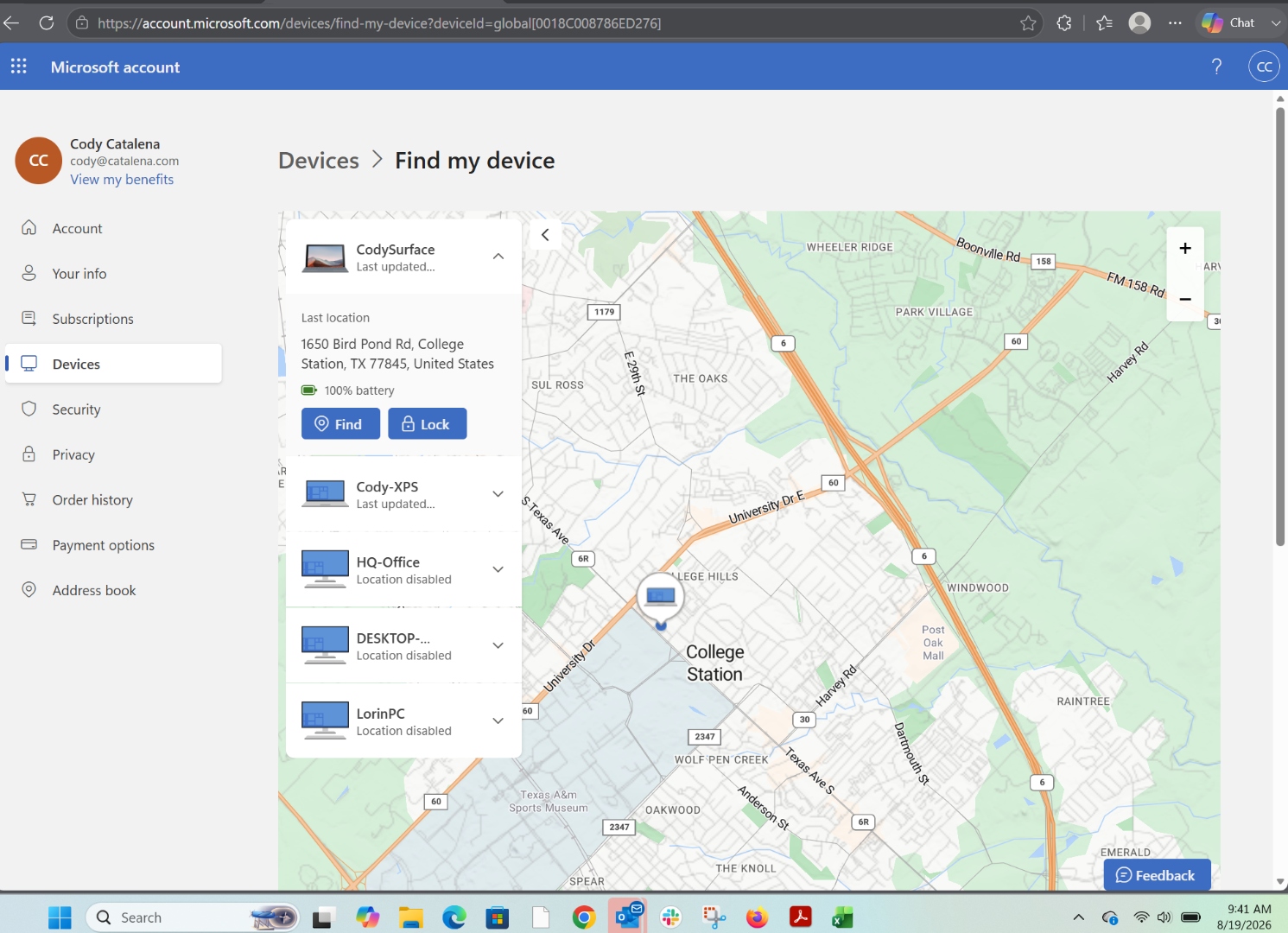
Refreshing the panel and selecting Microsoft's "Update location" control did not correct either address or either map pin during the capture window. Both devices are shown with addresses and pins that do not match each other and do not match the devices' actual location.
From portal.find.troverlo.com, the same Microsoft account owner, captured at 9:37–9:38 AM CDT on August 19, 2026 — inside the same two-minute window as the Microsoft screenshots.
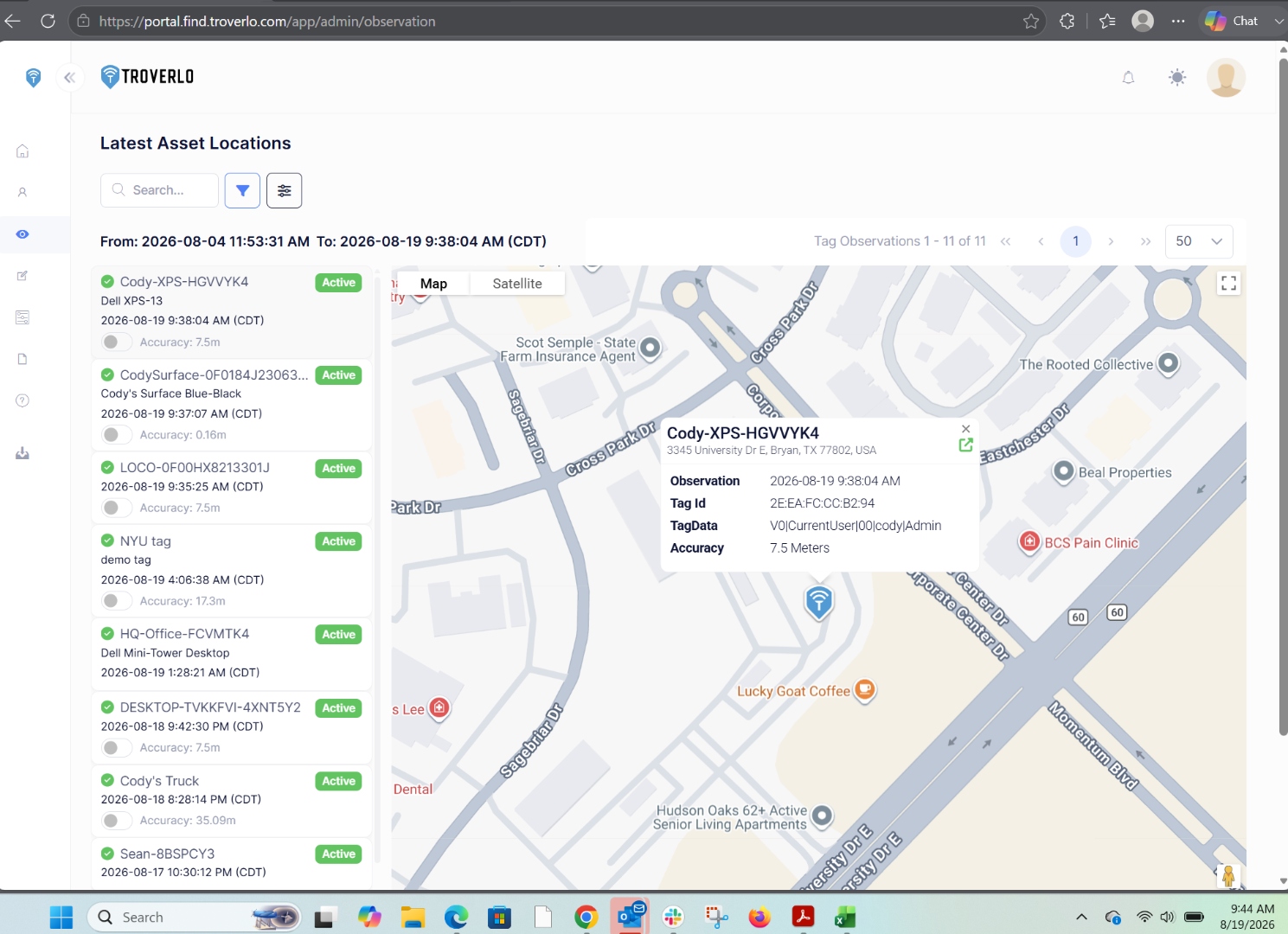
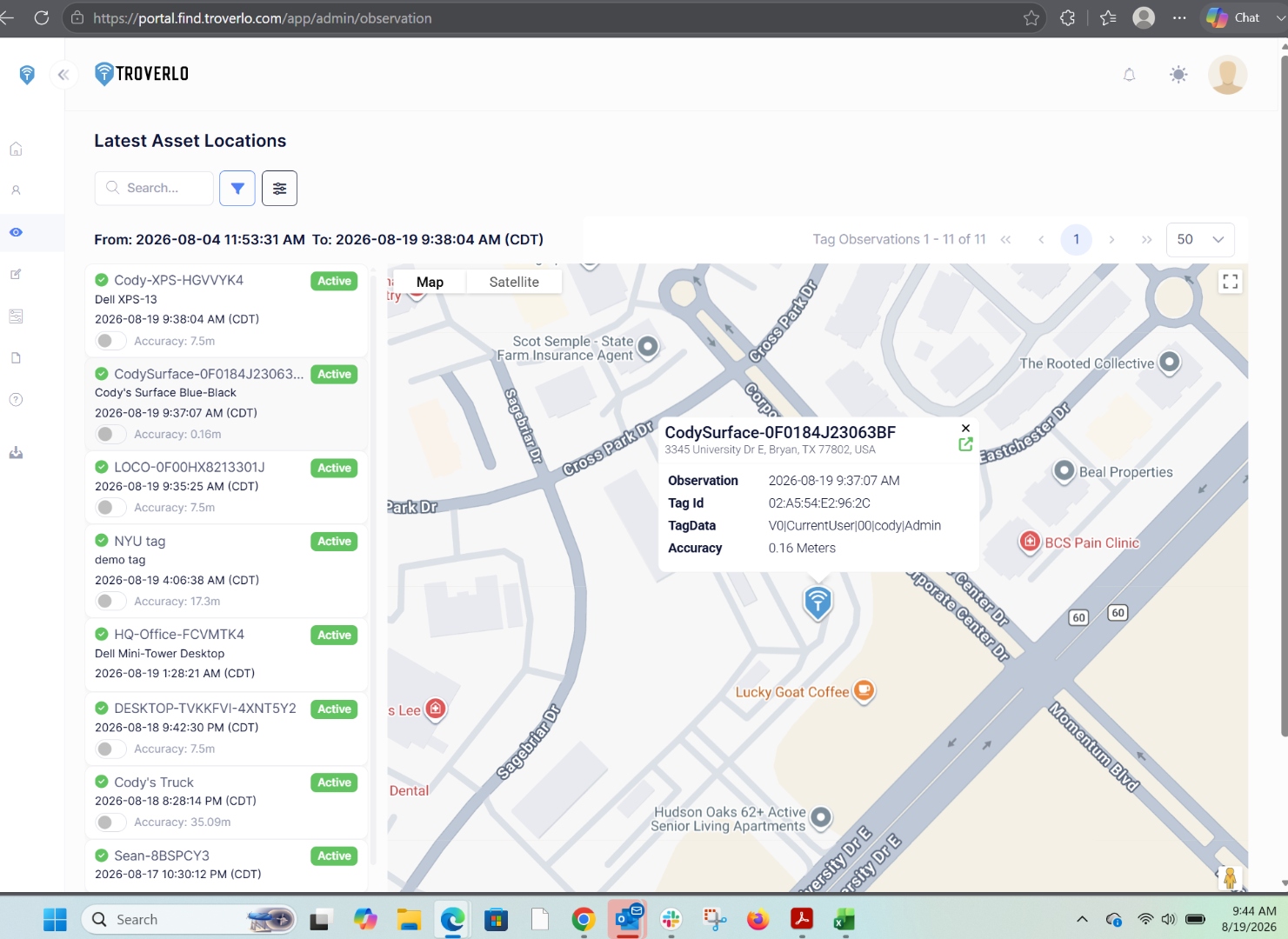
| Microsoft Find my device | Troverlo | |
|---|---|---|
| Freshness — online device (XPS) | 48 hours | Less than 6 minutes |
| Freshness — offline device (Surface) | Stale — device has not been at the address shown in over a year | Less than 7 minutes |
| Locates a device that is off-network | No — shows a stale last-known location instead | Yes — observed within the last 7 minutes |
| Address ↔ map pin alignment | Mismatch | Consistent |
| XPS location error vs. actual | ~5.5 miles | 7.5 meters |
| Surface location error vs. actual | ~10 miles | 0.16 meters |
| Requires the device to be online | Yes | No |
| Requires a cellular modem | No | No |
| Requires new hardware on the PC | No | No — uses the Wi-Fi radio already in the device |
| Location source | IP address and cached Wi-Fi / cell fingerprints | Direct observation of the device by a third-party Wi-Fi radio |
| Can be fooled by VPN or corporate egress rewrites | Yes | No — observation happens in the physical environment |
Location error compares Microsoft's returned address (Cody-XPS card) and displayed map pin to the actual physical location of the device (3345 University Dr E, Bryan TX). Troverlo's accuracy figure is the value reported on the observation record.
The PC reports its own location to Microsoft over the PC's own network connection. When the PC last checked in, Microsoft resolved that check-in against IP-geolocation databases and cached Wi-Fi and cell-tower fingerprints. The result is a location the PC says it is at, not a location a third party observed it at. When the device is off-network the last-known value stays put; when it is online the value can still be wrong by miles because the underlying IP or fingerprint lookup was imprecise or stale.
The device beacons a small identifier over standard Wi-Fi frames without associating to any network. Any Wi-Fi radio nearby — an access point, a vehicle, a partner device, another PC — observes the beacon and reports it back through the Troverlo Observation Network with the observer's own GPS-grade position. The location is where a third party actually saw the device, in the physical Wi-Fi environment around it. There is no IP address to look up and no fingerprint to guess. That is why CodySurface was located at sub-meter accuracy while it was offline and moving.
A walk-through of the ecosystem argument, the Troverlo technical brief, and a reference architecture. Introductions to Samsung Research America, SmartThings, Harman, or Samsung Electronics MX connectivity — wherever it should land — welcome.